
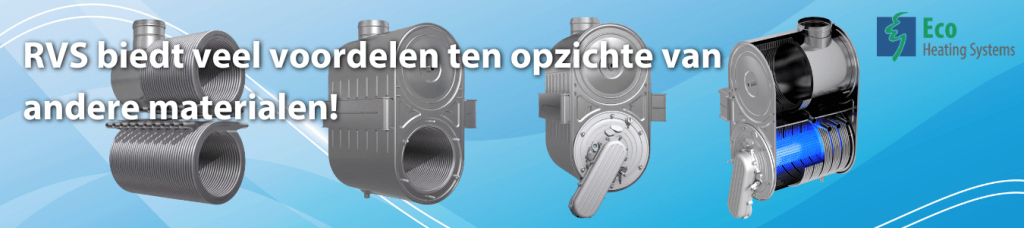
The heat exchanger forms the heart of every central heating boiler, making it vital to the system's performance and service life. Within this central component, heat from the burner is transferred to the heating water. The choice of material for the exchanger significantly influences the system's reliability, maintenance requirements, and overall lifespan. Consequently, there are notable differences between a stainless steel heat exchanger and an aluminum one. In this blog, we will dive deeper into these differences.
What is a heat exchanger?
A heat exchanger ensures that the heat released during gas combustion is transferred to the water in the heating system. Modern high-efficiency (HE) boilers also recover heat from the hot water vapor in the flue gases. This process, known as condensation, preheats the water in the heating system. As a result, less gas is required to bring the water up to the correct temperature, ensuring high efficiency.

Benefits of a stainless steel heat exchanger
There are several advantages to choosing a stainless steel exchanger over an aluminum heat exchanger. Below, we discuss the key benefits.
Longer system service life
Buildings such as offices, healthcare facilities, hotels, and schools require a heating system that can be relied upon daily. Stainless steel is a strong and durable material capable of withstanding high temperatures, temperature fluctuations, and prolonged thermal stress. This ensures the heat exchanger continues to perform optimally, even under demanding conditions. A longer service life results not only in reduced repair and replacement costs, but also in lower total cost of ownership.
High corrosion resistance
One of the greatest advantages of a stainless steel heat exchanger is its high resistance to corrosion. High-efficiency boilers continuously produce condensation as a result of recovering heat from the flue gases. This condensate contains acidic components that can eventually affect the materials inside the boiler. Stainless steel is naturally highly resistant to these conditions and retains its properties for many years.
Less sensitive to water quality
In utiliteitsgebouwen zijn verwarmingsinstallaties vaak omvangrijk en complex. Verschillende circuits, lange leidingtrajecten en meerdere warmtesystemen kunnen invloed hebben op de waterkwaliteit binnen het systeem. Een RVS warmtewisselaar is minder gevoelig voor variaties in waterkwaliteit, wisseling in PH-waarden en chemische belasting dan veel andere materialen zoals aluminium. Hierdoor blijft de bedrijfszekerheid van de ketel hoog.
Lower maintenance costs
Every central heating boiler or domestic hot water boiler requires regular maintenance. A heat exchanger that is less susceptible to fouling, wear, and degradation directly contributes to lower maintenance costs. Thanks to the robust properties of stainless steel, the heat exchanger stays clean longer, allowing the installation to maintain its efficiency over time. This minimizes boiler downtime and leads to lower maintenance expenses.
Ideal for high-capacity boilers
In de utiliteitsmarkt worden hoge eisen gesteld aan verwarmingsinstallaties. Hoge vermogens, continue belasting en maximale bedrijfszekerheid zijn belangrijk voor gebouwen waar de bewoners en/of bezoekers afhankelijk zijn van die ene installatie. Een RVS warmtewisselaar is bijzonder geschikt voor deze toepassingen in verwarmingsinstallaties.
All Eco Heating Systems boilers are equipped with stainless steel heat exchangers. They offer the reliability required for large-scale heating installations in sectors such as:
- Offices
- Healthcare facilities
- Hotels
- Schools
- Sports facilities
- Commercial warehouses
- Industrial buildings
Particularly in these applications, investing in high-quality materials pays off in the long run. Stainless steel provides a solid foundation for future-proof heating installations.
Would you like to learn more about heat exchangers or the products offered by Eco Heating Systems?
Although the heat exchanger is often invisible to the end user, this component has a major impact on the performance and reliability of a central heating boiler. For commercial and institutional buildings where reliability, sustainability, and low operating costs are key, a stainless steel heat exchanger offers clear advantages.
- High reliability
- Long service life
- Optimal corrosion resistance
- Low maintenance costs
- Suitable for intensive commercial and institutional applications
Choosing a high-quality commercial boiler with a stainless steel heat exchanger means choosing an installation that will continue to deliver efficient, reliable, and sustainable performance for years to come.
We would be happy to visit you to advise on which system is best suited for your needs. Of course, you are also welcome to visit us at our facility. There, you can see how we manufacture our central heating and hot water boilers and explore our applications. Contact us, we look forward to welcoming you.


 Back to the overview