
Organizations increasingly choose heat pumps for the heating systems of their office buildings. It is a fast way to enhance sustainability, save on energy costs, and comply with increasingly stringent laws and regulations. Especially within the commercial sector, the demand for high-capacity heat pumps is growing. In this article, you will learn how a heat pump for offices works, the advantages it offers, and what to consider when choosing a high-capacity heating system.
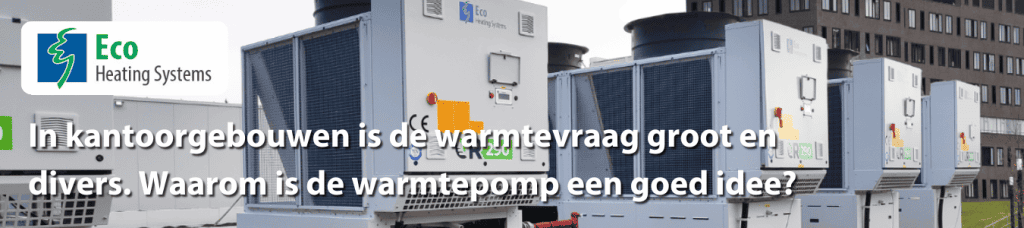
Why is a heat pump a good idea for an office building?
Heat demand in office buildings is both high and diverse, requiring specific heat delivery. Office buildings have large floor areas, often feature multiple climate zones, and have variable occupancy rates. In many cases, there is a simultaneous demand for heating and cooling. For instance, when the sun hits one side of the building, temperatures can rise significantly, while there is still a need for heating on the other side of the premises.
A high-capacity heat pump is ideally suited for this dynamic. Modern systems can both heat and cool, making them an integral part of an efficient climate system for commercial buildings.
High-capacity heat pumps for the commercial sector
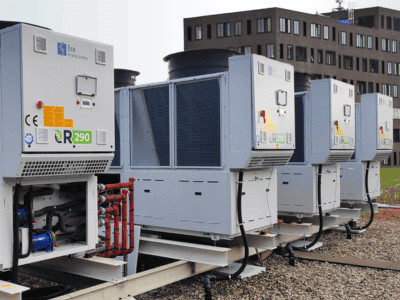
Standard residential heat pumps are insufficient for the commercial market. Therefore, heat pumps specifically developed for commercial applications are required.
Office buildings require:
- High capacities (often starting at a minimum of 30 kW)
- Cascade configurations (multiple heat pumps linked together) for scalability and operational reliability
- Reliable performance at low outdoor temperatures
- Integration with existing Building Management Systems (BMS)
High-capacity heat pumps provide the power to heat and cool entire office buildings. Through modulating compressors and smart control technology, the output is tailored to the actual heat demand. This provides the most efficient way of heating, resulting in a high Seasonal Coefficient of Performance (SCOP).
Heating and cooling with a 4-pipe heat pump
Modern heat pumps can heat and cool simultaneously. This is known as a 4-pipe system and can be a particularly interesting option for office buildings. Offices are often divided into zones, each with different thermal requirements. For example, certain zones may have high internal heat gains due to computers, lighting, data rooms, and people, while other areas require heating. The system offers the flexibility to respond to varying conditions per zone or floor. A 4-pipe heat pump can be perfectly integrated into a Building Management System and a GACS (Building Automation and Control System).
Energy savings and lower operational costs
Switching from a central heating boiler to a heat pump means transitioning away from gas and choosing electric heating. Moving to a commercial heat pump leads to the following benefits:
- Reduction in gas consumption or even completely gas-free heating
- Lower CO₂ emissions
- Improvement of the building’s energy label
- Lower Total Cost of Ownership (TCO) in the long term
A heat pump is exceptionally energy-efficient, generating more energy than the device itself consumes. The efficiency of a heat pump is expressed in COP and SCOP. With an SCOP of 4, 1 kWh of electricity delivers 4 kWh of heat. In combination with solar panels or sustainable power procurement, the system becomes even more attractive.
Hybrid System
If you wish to make your office building more sustainable in the short term, a hybrid heat pump is an attractive option. In a hybrid system, a heat pump works smartly alongside the existing gas-fired heating system. The heat pump handles the majority of the heat demand, while the boiler assists during peak loads or extremely cold winter periods. This can result in gas savings of up to 75%.
Compliance with laws and regulations
In the Netherlands, office buildings are subject to a minimum energy label requirement. Furthermore, governments and clients are increasingly pushing for the sustainability and electrification of heating systems. A high-capacity heat pump helps building owners and property managers meet these requirements and make future-proof investments.
Key considerations when selecting an office heat pump
When choosing a heat pump for the commercial market, the following factors are essential:
- Heat loss calculation and peak load analysis
- Available technical space and noise standards
- Integration with existing delivery systems (air handling, underfloor heating, radiators)
- Option for hybrid or all-electric systems and configurations
- Service, monitoring, and maintenance contracts
- Soort koudemiddel. R290 propaan is de toekomst. Vanaf 2027 is R32 als koudemiddel verboden.
A well-designed installation prevents oversizing, minimizes cycling (short-cycling), and maximizes efficiency.
Want to know more about installing a heat pump in an office building?
A heat pump for office buildings is a strategic investment in sustainability, comfort, and cost control—especially in the commercial sector, where power demand and operational reliability are crucial. By choosing a system specifically designed for commercial applications, property owners, advisors, and installers benefit from high performance, flexibility, and a future-proof energy supply.
The heat pumps from Eco Heating Systems are specifically developed for the commercial market. They combine a powerful heating system with reliability and quality. Would you like to know more about our heat pumps? Feel free to visit us; we have a commercial heat pump on-site for you to view. We would be happy to show you how it works.


 Back to the overview